


 Symmetry, perspective, the golden ratio, proportionality, the abstract and the angular; the mathematics of geometric shapes can be found in ancient Greek, Islamic and Renaissance art, through to the present day.
Geometry and art have a kinship that goes back millennia. Jewellery design is no stranger to geometry either. This is particularly true for diamonds cut for setting in diamond engagement rings, pendants and even crowns.
Every diamond unearthed is unique; taming it and enhancing its brilliance is the work of the diamantaire or diamond cutter. The cutting of facets requires a high level of skill and expertise to create geometric patterns that refract and reflect the light perfectly.
Selecting the right stone
Before the lapidary process of cutting a stone is the selection of the right stone. An artisan will take the time to inspect a diamond thoroughly before a single facet is cut.
Although natural diamonds have other uses, for example in drilling, only 5 per cent will ever be considered good enough to be cut and set into a piece of jewellery. The clarity, carat and colour will vary from stone to stone too.
Taking a rough stone, they will map out how best to use the diamond with minimal waste. They want to make sure that the best type of cut and shape is assigned to the stone to make the most of its natural beauty.
Microscopes and laser scanners can be employed to assist in the inspection and mapping process. Any imperfections and flaws will be revealed so the faceter knows the best direction to cut without shattering the crystalline structure.
A diamond’s many faces
Each cut of the stone is irreversible, so it must be exact. To create the dazzling effect of the gemstones, facets – flat, highly polished surfaces – are cut into them. It is a slow and meticulous process.
Throughout the process, the diamond cutter will stop and inspect the stone using a loupe, a type of magnifying eyeglass. This enables them to see the details and flaws that are invisible to the naked eye.
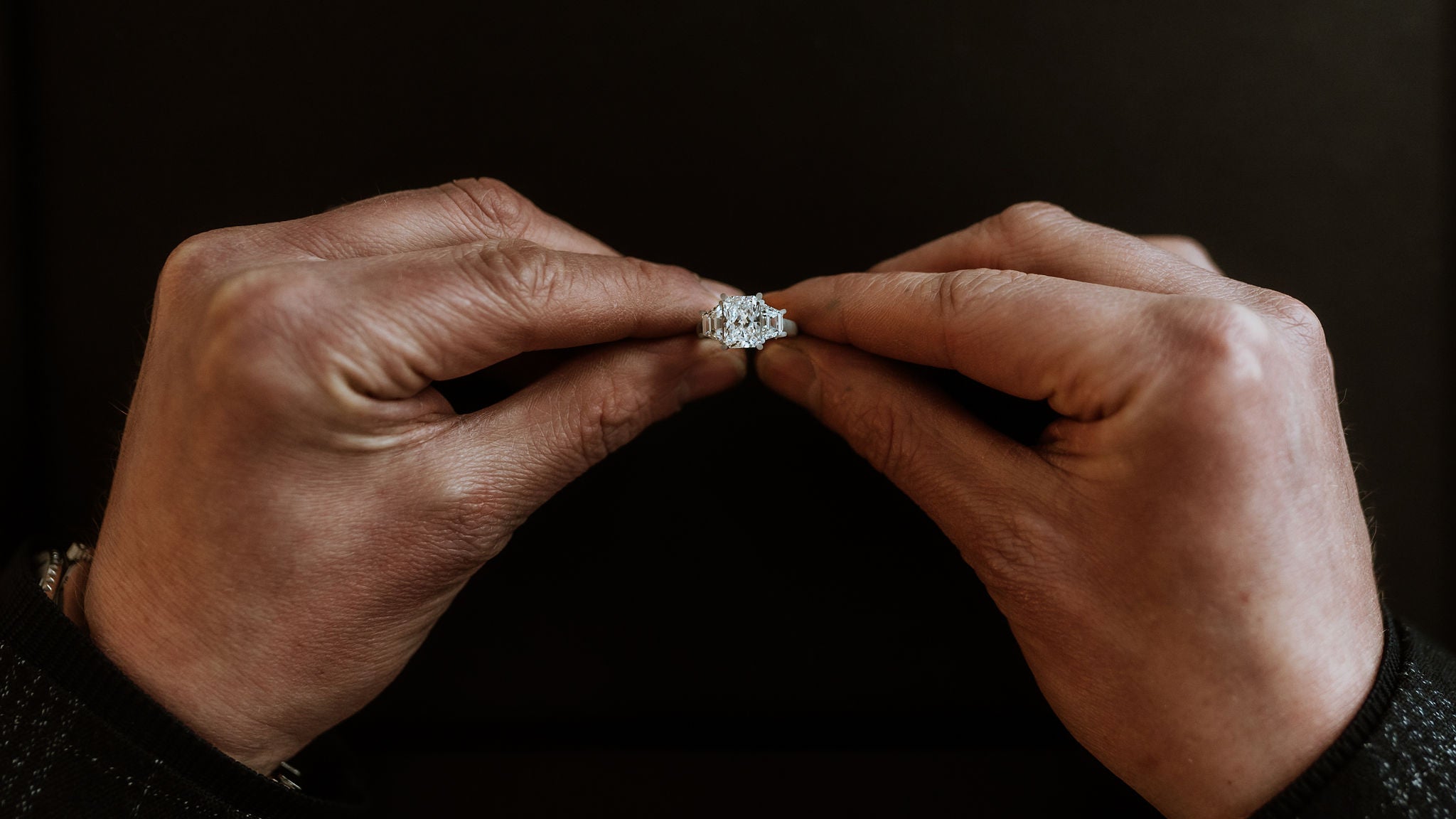
Aligning the planes of the facets at angles in different geometric patterns is what creates the final shape of the diamond. The pattern is arranged around a central shape on the top called the table, for example, an emerald cut would have a rectangular shape table.
Angled facets play out from this shape until they reach the widest part of the diamond, the girdle. Facets cut between the table and the girdle are crown facets. Pavilion facets are then cut down to the point on the underside, called a culet.
Through the hall of mirrors
The crystalline structure of diamonds lends itself naturally to geometric shapes, but none are quite so clearly mathematical as the angular cuts of Asscher and emerald shapes.
The step-cut facets of these shapes give them the illusion of a window into another world. By using concentric step facets that begin with a small rectangular or square table, the diamond cutter can work magic with reflected light.
The Asscher and the emerald cuts both have parallel, rectangular facets, unlike a round or oval cut, which features triangles or kite shapes.
As each facet works with the other three sides to create a series of rectangles that pull you into the gemstone – a mirror within a mirror within a mirror, like an optical illusion. The depth of the pavilion for these diamonds adds to the effect.
When the facets work together, it creates the sparkle we are used to associating with diamonds. The flashes of light and shadow across the stone, the fire of rainbow colours when the light refracts and splits, and the bright white of its brilliance.
Asscher versus emerald diamonds
Emerald diamonds are not, as the name suggests, green at all; they simply inherited the name from the step-cut technique used on the deep green gemstones.
Asscher diamond cuts developed from these techniques, via the Royal Asscher Diamond Company in Amsterdam.
Both diamond cuts use a step-cut technique to produce the hall of mirrors effect. However, the main difference is that an Asscher is more square, giving the face view a windmill-type effect, whereas the emerald is more rectangular.
Should you choose an Asscher or an emerald diamond for your engagement ring?
Both types of diamond will look stunning on your ring finger, but choosing between them is a hard decision.
Asscher
Choose an Asscher diamond engagement ring if you want geometric flashes of light and brilliance. Note that an Asscher cut will show every flaw, so expect to pay slightly more for better clarity.
Emerald
Slightly more understated than the Asscher, but the emerald still has classic good looks, and the longer shape can be more flattering on the finger. It also has the advantage of size over the Asscher.
For those looking for a mesmerising cut and a vintage aesthetic, both shapes are an excellent choice for a diamond engagement ring. The final decision might be up to you and your budget.