
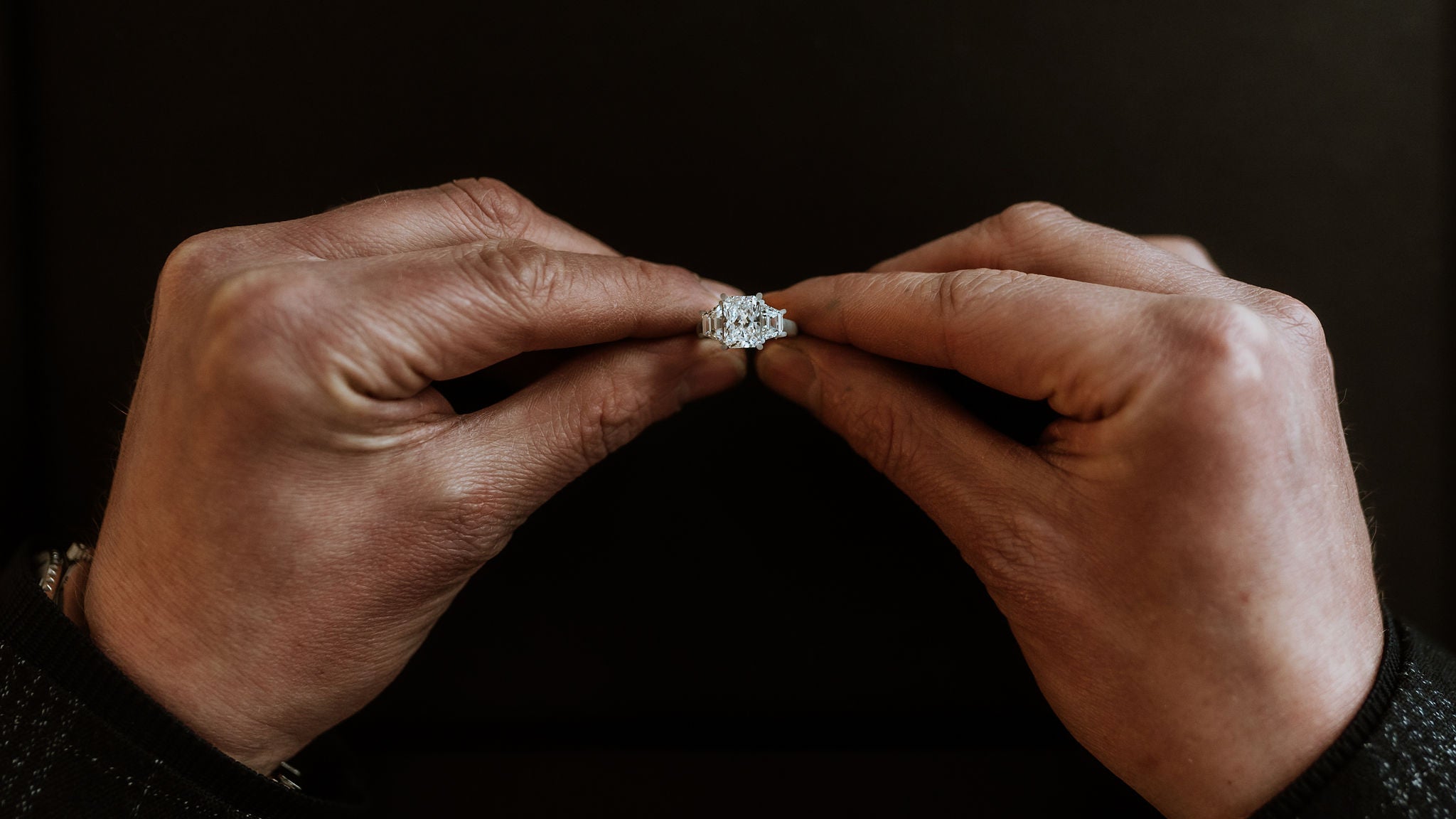
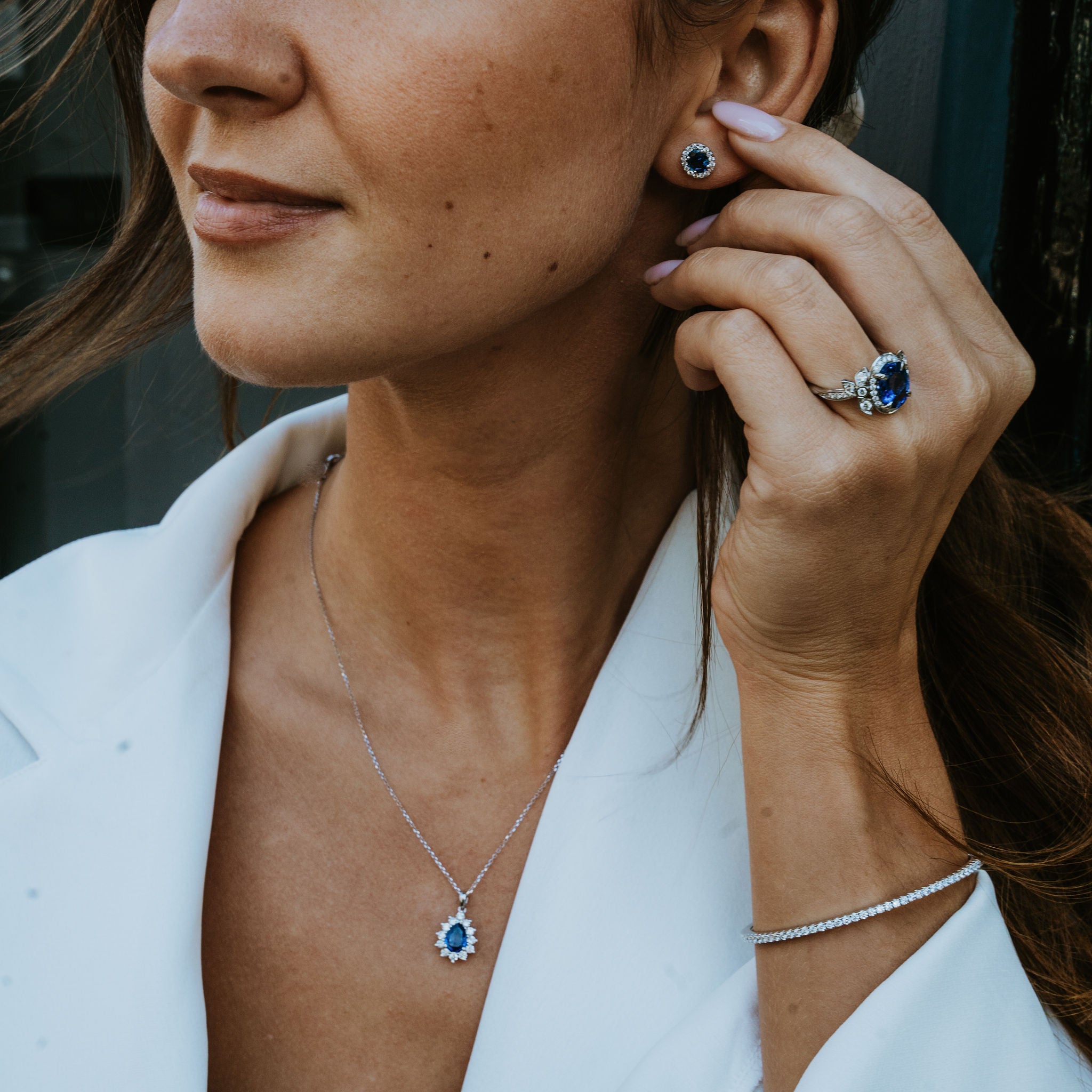


There are many ways to wear a diamond, but a pear cut ring is one of the most distinctive and beautiful of all. They are particularly popular in engagement rings and you can enjoy a beautiful bespoke version of your own for this very occasion.
If you are looking for a ring that truly stands out, few can be more distinctive than a pear cut because of its distinctive and curved shape.
What Is The History Of The Pear Cut?
The origins of some cuts of diamond are not particularly clear. However, this is not the case for the pear cut:
- Its inventor was the 15th-century Flemish jeweller Lodewyk van Berquem
- He made it using the scaife, a diamond-polishing machine that he invented, which revolutionised diamond preparation.
- According to the International Gem Society, he invented both the scaife and the pear cut in 1475, although other authorities cite different dates, such as the 1450s.
- Features of the pear cut included having 58 facets to maximise its sparkle, a number which remains the standard today.
Because the pear cut comes with a distinctive asymmetry, it is usually worn as a solitaire to help it stand out.
That makes it a very popular choice as an engagement ring, as solitaires are generally favoured and this particular kind will stand out more than most. That said, it can also be used as the central stone in a trilogy ring.
Having been around for centuries, it may not come as a surprise that there have been some minor variations in what is fashionable, generally through some diamonds being wider and others narrower.
You may even come across some vintage rings that have pear cuts, which could provide you with some inspiration if you want a bespoke version.
Are Pear Cut Diamonds A Popular Choice For Engagement Rings?
The modern popularity of the pear cut is not in doubt. Indeed, many celebrities have worn them as engagement rings. These include:
- Avril Lavigne
- Holly Valance
- Katherine Heigl
- Jessica Simpson
What is notable is that the designs were different from each other, highlighting the potential for bespoke creations to offer uniqueness and beauty alike.
For instance, Jessica Simpson went for a trilogy ring with three pear cut diamonds and Katherine Heigl had a diamond halo around the central stone, as well as the ring using platinum taken from her mother’s wedding ring.
These variations show just what can be done. Our work also shows off some superb designs, such as this one:
<insert media here https://www.youtube.com/shorts/8mLX-W9X5m0 >
What Can A Hidden Halo Add To A Diamond Ring?
Among the elements that can make a pear cut diamond stand out is the hidden halo. This involves a diamond halo that is set to the side of the ring below the stone, making it invisible from above looking down, but clearly visible from the side.
This has the appeal of making the ring look minimalist, yet adding some extra sparkle. It can be done with different cuts of diamond ring, but, given how wonderfully sparkly a pear cut diamond is already, this adds even more.
Because it lives up to its name, it also means a hidden halo enables you to enjoy the perfect combination of a bit of extra sparkle that can be enjoyed at close quarters, while avoiding the impression of anything too ostentatious.
Why Is Using Lab Grown Diamonds A Good Idea?
The finished work will always look wonderful, but the origins of each diamond are also worth thinking about. The ethics of the acquisition of diamonds have been a major issue for many years, with a variety of concerns:
- Diamonds have a history of being traded to fund crime or wars
- Miners in the developing world have often worked in unsafe conditions with poor pay
- Transporting diamonds from mines to jewellers thousands of miles away carries a high carbon footprint
The first of these issues has been largely addressed by the Kimberley Process, which covers 99.8 per cent of the world diamond trade and enables them to be traced and therefore not sold to help fund conflicts.
However, the other issues remain and there is an alternative that we will happily use, which is to have lab-grown diamonds.
It may seem extraordinary that gemstones such as diamonds, which took millions of years to create in the earth’s crust, could be manufactured quickly in a lab.
However, this is possible because we know the chemistry and can recreate the conditions that turn pure carbon into diamonds by recreating the 3D isotropic structure found in mined diamonds.
Crucially, they are classed as real diamonds, rather than imitation diamonds (such as moissanites or cubic zirconia), as they have the same structure and chemistry, as well as the maximum hardness of 10 on the Mohs scale.
Consequently, a lab-grown diamond will be just as hard and just as sparkly as something that came from a mine after millions of years in the ground.
What Skills Are Involved In Shaping Pear Cut Diamonds Today?
What remains is for our skilled craftsmen to turn the diamond into a beautiful pear-shaped gem.
This will be done using a combination of traditional tools and skills, plus modern aids such as microscopes to enable us to see what we are doing as we shape gems and rings with minute precision, creating a wonderful bespoke item that reflects your wishes and our skills.
There are no more traditional tools than the scaife. Centuries on from Lodewyk van Berquem, this device and its use of diamond dust to polish diamonds points to the simple reality that there is no better material to do this than the only substance hard enough.
A pear cut ring combines novelty, sparkle and tradition. We can produce a bespoke version for you that will be truly worthy of the dreams your engagement represents.
Frequently Asked Questions:
How long has the pear cut been around?
Depending on who you ask, it was either in 1458 or 1475 that it was invented, but there is no dispute that it was by Lodewyk van Berquem in Flanders.
Do you still use the scaife to polish and shape diamonds?
Yes. There remains nothing better than diamond dust to cut and shape diamonds, as it is the only material hard enough.
Do pear cut diamonds have a standard size and shape?
No. They can be broader or narrower and their size can vary. What does not change is the standard 58 facets.
Do lab-grown diamonds look exactly the same as mined diamonds?
Yes they do. Nobody would know the difference unless you told them.