


Gold is such a familiar metal to us that it may seem as though there’s only one simple definition of it in jewellery… that beautiful yellow metal rings, bracelets, earrings and necklaces are made out of.
Yet, in reality, yellow gold is in a category all of its own.
How Is Yellow Gold Defined?
The yellow gold you see in jewellery is a mix of gold and other metals that retains its yellow colour, rather than looking silvery like white gold or pinkish like rose gold, which are still classed as gold.
The metal, in pure form, is an extraordinary substance.
Gold is an element, classified by the symbol Au and the number 79 on the periodic table. It cannot be made of any other metal (except platinum, which is even rarer) and, like other elements, is made inside stars.
The term ‘yellow gold’ may seem a little superfluous, even as a term for jewellery. Moreover, some might ask, hasn’t yellow gold always been, straightforwardly, ‘gold’? The reality is more complex.
Of course, anytime an archaeologist today stumbles across an ancient gold hoard, they will immediately recognise it as yellow gold. Indeed, the use of gold in coins and jewellery is very old.
Gold has been used in making coins since around 640 BC in the kingdom of Lydia, albeit as Electrum, an alloy of gold and silver. Pure gold was first used in coins by King Croesus between 561 and 547 BC.
Examples of the use of gold in jewellery include the burial mask for Egyptian pharaoh Tutankhamen, who died in 1323 BC.
However, not all gold is the same, which is important when understanding the definition of yellow gold.
How Is Gold Purity Measured In Karats?
Nearly every gold item you ever see will, in fact, be an alloy, consisting of gold mixed with something else. The karat (kt) classification system describes how near it is to 100 per cent pure gold.
For example, 24 kt gold means it is 100 per cent pure. You won’t see this in any jewellery, but would if you encounter any gold bullion bars.
Lower karats indicate reduced purity, which is necessary as gold is so soft and alloys that mix in harder metals will make it harder to scratch or bend. Indeed, the softness and excessively bright colour of 24 kt gold makes it unsuitable for jewellery.
In many countries, at least 10 kt (41.7 per cent pure gold) is required for the metal to still be legally classed as gold.
The higher the karat, therefore, the nearer it is to pure gold, but this does involve some trade-offs. The hardness level is one factor, but so is the colour. Indeed, to be classed as ‘yellow gold’ does require a higher karat level.
Most jewellery is 18-22 karat gold and, therefore, if you come to us seeking bespoke jewellery made of yellow gold, it is likely to be at least 14-18 kt.
This will still have a beautiful yellow hue, while being tougher than 22 or 24 kt gold and therefore much more suitable for frequent wear.
How Does Yellow Gold Differ From Rose Or White Gold?
The distinction between yellow, rose and white gold is not a simple matter of karats, however.
- Despite its pinkish colour, rose gold contains as much gold as yellow gold. It can be as high as 18 kt yet looks rather different because of the other metals used in the alloy, primarily copper. A little bit of silver is added to reduce the reddish tint.
- White gold uses white metals such as palladium or nickel to create a more silvery colour. However, it comes with the advantage of being harder than sterling silver.
- Yellow gold retains the colour more akin to that of pure gold through the use of metals such as copper and silver, although zinc may also be added. In a typical 18 kt yellow gold item, the alloy will be 75 per cent gold, 15 per cent copper and ten per cent silver.
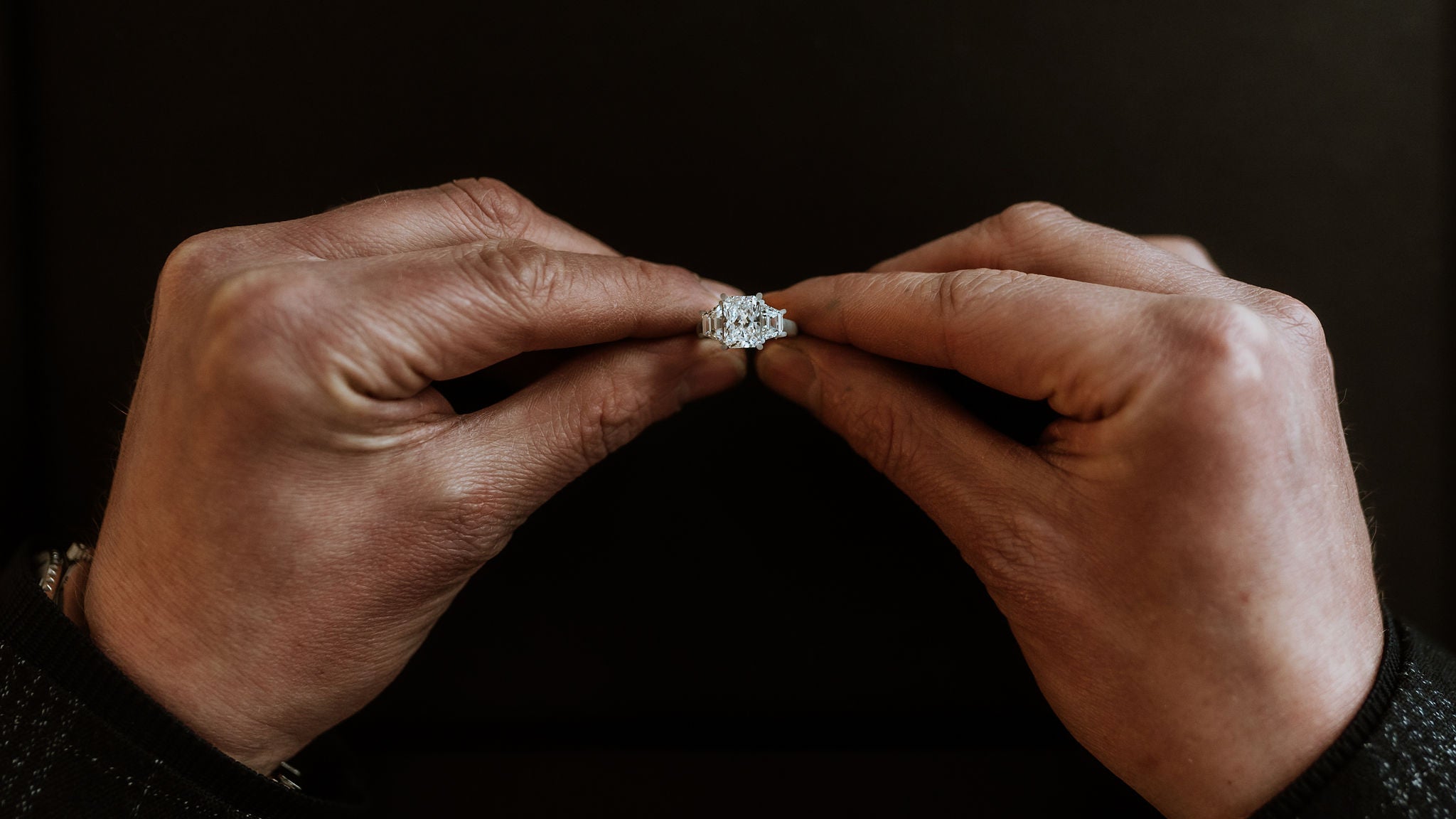
We use yellow gold for some beautiful items of jewellery, such as this fine ring with a rare yellow diamond set in it:
How Is A Yellow Gold Alloy Made?
However, getting to the point where the beautiful final ring is in place and can have gems set in it is a lengthy process, not least because of the alloy-making process involved.
Gold melts at 1,064 degrees C, so specialised equipment is needed to liquefy the metal in the first place. It is in this state that other melted metals can be added.
This is a lower temperature than that at which most metals melt, which contributes to the malleability of gold, making it easier to shape into jewellery.
However, an 18kt yellow gold alloy containing some copper and silver will actually melt at 1,050 degrees C. This is partly because silver is one of the few metals that melts at a lower temperature than gold (961 C), although it is slightly higher (1,084 C) for copper.
Melted metal is mixed in a pot known as a crucible, with this being taken out of a furnace with the help of pliers and some extremely thick gloves. It is as the metal cools that it can be reshaped.
Where Does The Gold We Use Come From?
This malleability and ease of melting not only enables newly-mined gold to be shaped into jewellery, but also for recycled gold to be used as well. Indeed, over a quarter of the global gold supply is made up of recycled metal, with around 90 per cent of it from jewellery.
Of course, new gold is still mined all the time, with a very small amount of it coming from the UK. There is even one small gold mine in Scotland.
However, we use 100 per cent recycled gold as standard, although we can also offer Fairtrade gold and single mine origin metals.
With our team of skilled goldsmiths, we carry out the full process in-house. This means we do all our own casting, which enables us to control the alloys we use. As a result, we can provide a better traditional hand-crafted finish and therefore a finer product.
Furthermore, with training in using traditional tools, we observe time-honoured traditions and tried-and-tested methods to produce beautiful and intricate jewellery.
Yellow gold has always offered huge possibilities for making stunning jewellery. With the right mix of alloys, great skill and experience, we can produce something truly wonderful for your special purpose.