
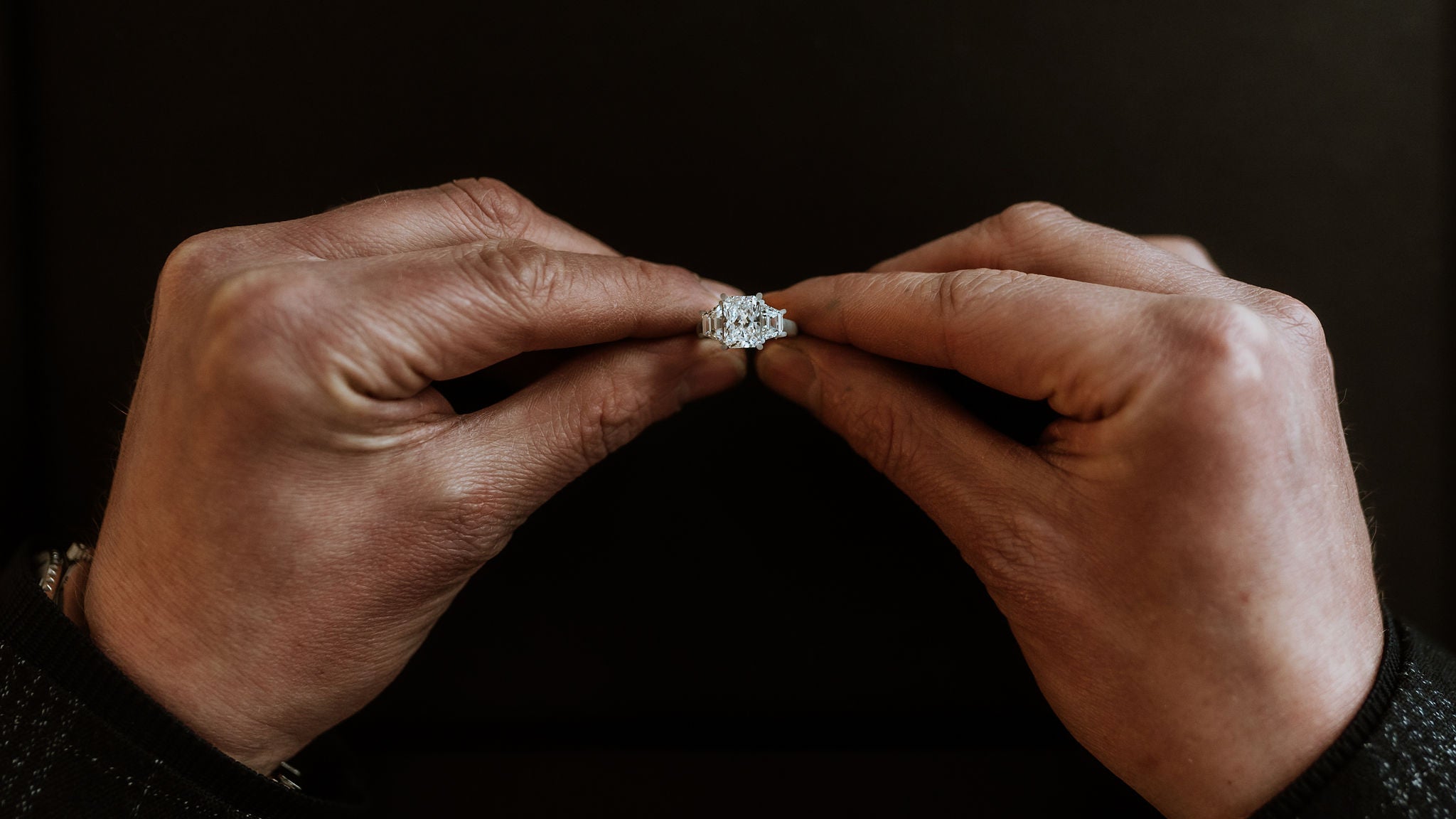





 There are many combinations of different gems that can make great bespoke jewellery. When it comes to necklaces, pearls and diamonds are among the very best matches, with one of our finest creations demonstrating just what is possible.
As the old adage goes, “diamonds are a girl’s best friend.” But pearls are also very popular - and a string of them around the neck will always be a classic style choice.
Of course, this is just one of many ways in which pearls can be worn.
In some cases, a single large pearl can act as a focal point rather than one of a collective, which enables the following:
- It stands out from the rest of the necklace
- Use of different colours for striking visual effects
- Other complementary features can be brought in
Watch: A Single Pearl Combined With Diamonds To Make A Stunning Necklace
The last of these features is certainly true when diamonds are used. Indeed, we have produced just such a necklace ourselves:
This outstanding necklace features both a large Tahitian pearl and mined diamonds. The latter might sound more familiar than the former, but there is something very special about Tahitian pearls.
What are Tahitian pearls?
Of course, everyone has heard of Tahiti, the beautiful tropical island in the Pacific… but not everyone knows that the pearls are in a class of their own.
Like any pearl, it is not a gemstone, but rather a smooth collection of hardened nacre, a substance released by molluscs to cover grit, which would otherwise be an irritant when it gets in the shell. In oysters, this builds up to form pearls.
What Is So Special About Tahitian Pearls?
However, in the case of a Tahitian pearl, the colour is different from the familiar white or off-white shades we commonly see. Instead, it is a much darker colour, a shiny, almost metallic black.
Key facts about these pearls include:
- They are the only naturally occurring black pearls in the world (others are artificially treated to attain the colour).
- They are found in the black-lipped Pintada oyster, which is native to the south Pacific, mainly the lagoons and island coasts of French Polynesia.
- Most Tahitian pearls used in jewellery are produced in commercial oyster farms in Indonesia.
- It takes up to three years to fully grow a Tahitian pearl and only one can be produced at a time, compared with up to 30 at once for freshwater pearls.
- Tahitian pearls were introduced to the world of jewellery by Salvador Assael, founder of the jewellery brand of the same name.
Therefore, a Tahitian pearl is simultaneously stunningly beautiful, very rare and spectacularly different to other pearls. This makes it a prime candidate to be worn as a single, large pearl in a necklace.
Using Small Diamonds To Complement Big Pearls
Complementing such a pearl may not be easy, but diamonds can certainly achieve it. Indeed, in most items of jewellery, diamonds are the centrepiece, often as the largest stone.
Therefore, for diamonds to play a supporting act requires something exceptional to be the centrepiece, which is exactly what a Tahitian pearl is.
In the case of this necklace, the diamonds are small and arranged in a pattern, providing something delightful and crafty. This is a design that maximises the appeal of a sparkling cluster of small diamonds, while still allowing a big, dark pearl to take centre stage.
It is a delicate balance, but by making the diamonds themselves delicate, it can be achieved.
The diamonds in this particular necklace are mined rather than lab-made. The latter process is more than good enough to ensure that almost nobody can tell the difference, but there is still something wonderfully authentic about diamonds that have been dug up from the ground.
Diamonds are commonly mined in the following places:
- Russia, the largest producer, although for geopolitical reasons, this is not where Western countries get their supplies at present
- West African countries like Guinea and Sierra Leone
- Central and Eastern African countries such as Congo (Kinshasa) and Tanzania
- Southern African nations like South Africa, Namibia, Botswana, Zimbabwe, Lesotho and Angola
- Canada
- India
How Has The Kimberley Process Made Mined Diamonds More Ethical?
The locations that some diamonds come from, such as Canada, pose no ethical issues, but, historically, there have been some concerns about diamonds mined in developing countries, including unethical labour practices and, on occasion, their use to fund war and crime.
However, to combat and eliminate the scourge of ‘blood diamonds’, the Kimberley Process Certification Scheme was established in 2003. What this does is:
- Ensures strict regulations in all participating countries to control the import and export of diamonds
- Full transparency in the supply chain, so it is clear where traded diamonds are going
- Trade is only allowed between Kimberley Process members
- Mandatory Kimberley Process certification for every exported diamond
Membership of the Kimberley Process includes almost all countries and companies with involvement in the rough diamond trade, along with regulatory bodies and civil society groups to provide extra oversight.
As a result, 99.8 per cent of the diamond trade is now covered by the process, which minimises the supply of conflict diamonds to fund rebel paramilitary groups and also ensures that consumers around the globe can be confident that their diamonds are conflict-free.
This transformation of the diamond mining industry’s ethics means you can turn your focus back to the stunning craftsmanship and beauty of the diamonds and the skill involved in cutting and shaping very small stones, as well as the way they are set in an elegant pattern.
Our video shows the final result of the craftsmanship, highlighting how the perfect juxtaposition of sparkling diamonds and the rarest of pearls can provide something truly exceptional.
It shows just how extraordinary bespoke jewellery can be.