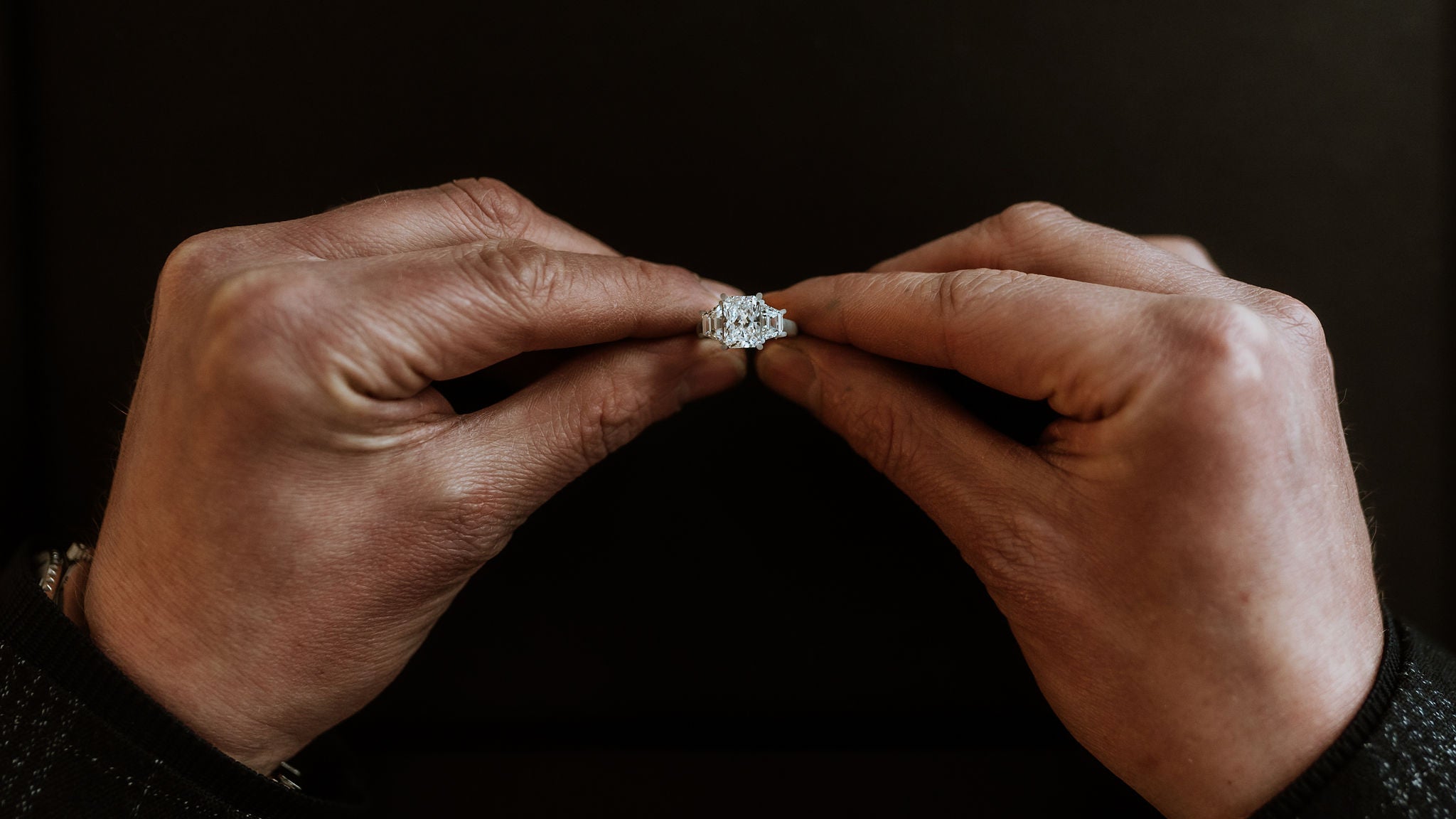

 There are many different cuts of diamond that you could wear as an engagement or wedding ring, providing a variety of styles to choose from. But what does a brilliant cut diamond ring offer, and what can enable the cut to justify such a name?
Different styles of diamond cut rise and fall in popularity, but in the case of the Brilliant Cut, this is a relative latecomer, arising as the endpoint of many centuries of developments in diamond cuts. The brilliant cut emerged in the 19th century, rounded and with 58 facets.
This was made possible by advances in cutting technology and fashion, which produced the round cut and enabled more sparkle to be produced by the addition of a large number of facets.
How Did Mathematics Produce The Most Brilliant Cut?
However, the 19th-century Brilliant Cuts later became known as the ‘Old Cut’, of which there were three versions: Old European, Old English and Victorian. The ‘old’ term is used because there was a further, 20th-century modification still to come. This next step was taken in 1919 by Marcel Tolkowski, a young member of a family of jewellers.
He applied some smart mathematics and calculated that the ‘brilliance’ of a diamond (measured by the amount of white light being visible) and its ‘fire’ (dispersed light) could both be maximised if the cut was made within a range of tolerance. This newer version, the Tolkowski Cut, became the next iteration of the modern Brilliant Cut.
There is some possible variation, although there are at least 57 facets, but the key point is that this particular style of diamond is designed to precision with the specific aim of maximising the qualities of the light. It has become increasingly popular over recent decades.
As such, this particular style of diamond marks a departure from some of the other cuts.
What Makes The Brilliant Cut Different From Other Diamond Cuts?
Some would argue that no diamond is anything less than brilliant in its capacity to sparkle and delight, especially those with many facts and that is true enough. However, what the brilliant cut, or at least the Tolkowski version, represents is a particular effort to maximise the light and to make this the primary aim of cutting the diamond in that specific way.
To appreciate the difference, let us consider some of the other cuts and how they differ:
· The Emerald Cut, as the name suggests, originated with emeralds in the 1500s and was designed to alleviate the propensity for those softer gems to chip. It only became fashionable to cut diamonds in this style from the 1920s onwards.
· The Asscher Cut actually emerged earlier (1902) than the fashion for applying the Emerald Cut to diamonds, but it bears many similarities.
· The Pear Cut dates from the late 15th century and the invention of a new polishing machine by Flemish jeweller Lodewyk van Bercken, setting the scene for rounded cuts with facets placed in perfect symmetry, paving the way for the later development of the brilliant cut.
What these varied cuts and their different origins show is that, in some cases, such as the Emerald Cut, the origin was not actually about sparkling diamonds at all. Its continued popularity owes much to the overall shape rather than its particular light qualities, in particular because it fitted with the Art Deco styles that became wildly popular in the 1920s.
At the same time, the development of rounded diamonds with symmetrical facets made possible by Lodewyk van Bercken undoubtedly paved the way for innovations such as that of the round Brilliant cut, but the emphasis on the ‘brilliant’ was taken to ever higher levels until it reached its zenith with the mathematical optimisation achieved by Tolkowski.
Is The Brilliant Cut The Right Diamond For You?
This leaves the question of whether a brilliant cut is the ideal diamond for you.
A first consideration is whether you want the sparkle to be the most important thing, in which case, a brilliant cut is a prime candidate for your ring, although others, like a Pear Cut, should certainly be considered.
Against that, you may ask yourself whether a rounded cut is what you want, which would make a round Brilliant, Pear or an Oval Cut an option. If you prefer something more rectangular or elongated with some straight lines, you should consider an Emerald Cut, Asscher Cut, or perhaps a Princess Cut.
The other consideration is whether this diamond is to be a solitaire or combined with other stones, such as in a trilogy ring.
Whatever you choose, we can offer a bespoke design that will ensure that your diamond engagement or wedding ring looks stunning, providing you with something beautiful that you will be delighted to wear for the rest of your life.