



Most people looking for a beautiful engagement or wedding ring will seek familiar gemstones, but there are some superb alternatives out there that many people don’t know much about. Tanzanite is a case in point.
Tanzanite is a form of the mineral zoisite found in northern Tanzania. Originally dubbed ‘Blue Zoisite’, the name was changed to Tanzanite to reflect its origin.
It comes from a few mines close to the town of Arusha at the foot of Kilimanjaro, an area familiar to tourists trekking to the top of Africa’s highest peak.
Key facts about the stone include:
- Although known for centuries, it wasn’t found in commercial quantities until the late 1960s.
- It comes from just eight mines
- It has become the second most popular blue stone after sapphires
- In 2002, it was designated a birthstone for December
- It features a strong pleochroism, which means it can reveal different colours when viewed from varying angles.
- The blue colour comes from a mineral called vanadium
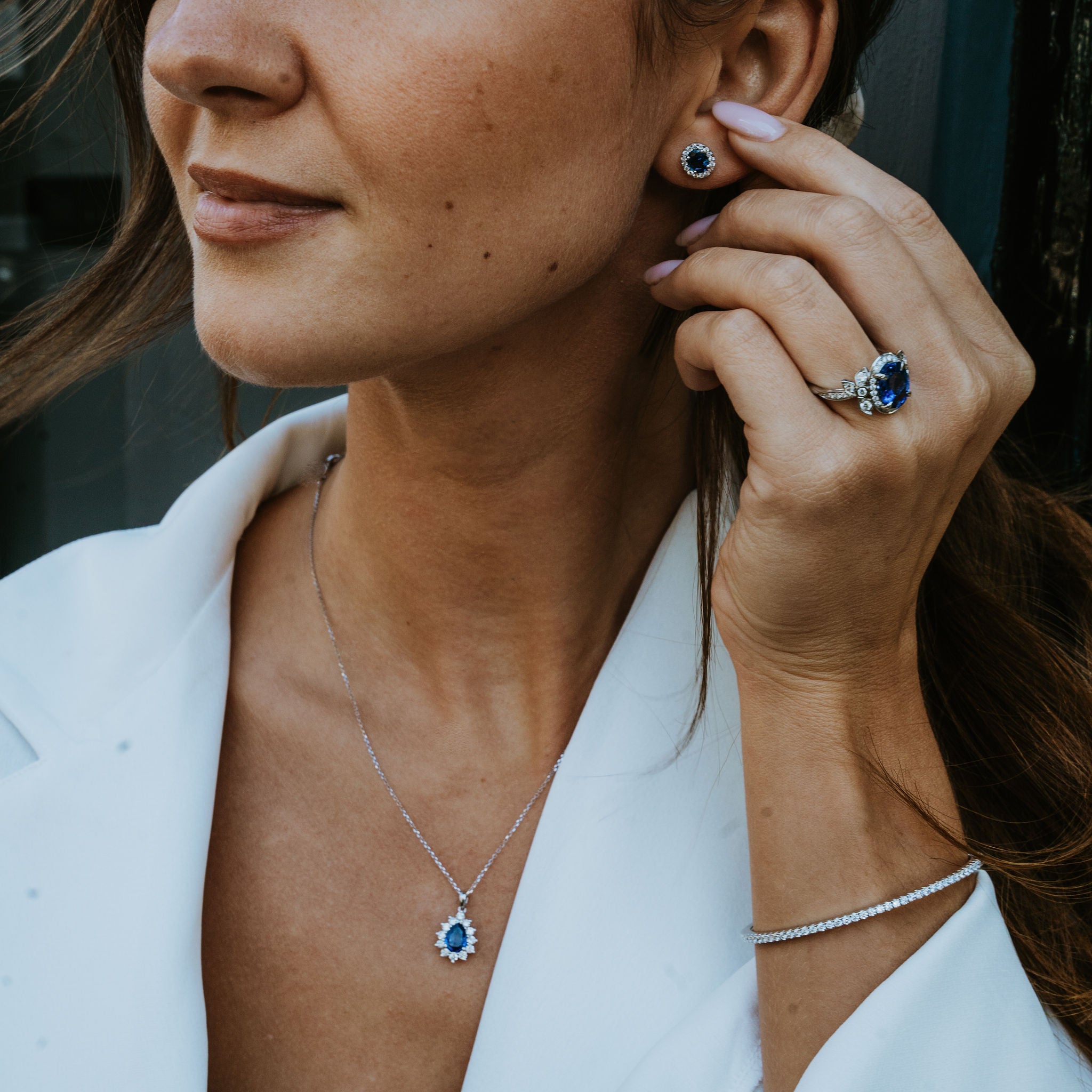
Tanzanite’s qualities and features make it a popular choice for gemstone jewellery and we have used it ourselves, such as in this example:
What Skills Are Involved In Making Tanzanite Rings?
Making such jewellery requires a lot of skill and traditional craftsmanship, even though jewellers have only been working with blue Tanzanite for half a century.
A key part of the approach is to deal with this mineral like other stones that are comparatively soft. Tanzanite measures 6.5 on the Mohs scale, which is not only much less hard than diamonds (10) and rubies and sapphires (9), but also emeralds (7.5).
Normally, only the hardest stones are recommended for engagement or wedding rings, as they are not susceptible to being chipped or cracked. If a stone like an emerald is used, it is usually set in a way that provides protection against being chipped or scratched.
This does not mean Tanzanite is soft per se; it is literally as hard as nails (steel nails are also 6.5). But that still leaves it relatively susceptible to impacts.
Our approach to this issue is to design the ring in such a way as to offer extra protection while retaining or even enhancing the aesthetic quality of the ring.
In the case of the ring in the video, the diamonds play an important role beyond the aesthetics, as they offer maximum hardness. But the silver prongs that encase the Tanzanite offer an extra barrier against impact, as well as being an aesthetic feature in itself.
This ring is quite similar in style to the popular ‘Diana Ring’, which features a large sapphire surrounded by smaller diamonds. The exception is that the sapphire is normally standing proud rather than surrounded by prongs, due to the hardness of corundum.
A key element of the craft involved is to shape the prongs to resemble leaf shapes, to go with the petal shapes bearing small diamonds on either side of the tanzanite.
FAQs About Tanzanite
Would you love a ring like this? If so, you will be in good company. But you may also have a lot of questions to ask about tanzanites. Here are some of the most frequent:
Is Tanzanite A Valuable Stone?
Only four stones (diamonds, rubies, sapphires and emeralds) are classed as precious stones, with the rest being semi-precious.
Nonetheless, Tanzanite is valuable because of its rarity and if you want a blue stone on a ring, it is second only to sapphires, putting it ahead of alternatives such as aquamarine or blue topaz.
As with other stones, the value of any particular gem depends on its quality, such as the saturation level of the blue colour.
However, because Tanzanite is scarce and only comes from one area, the mines may be exhausted 20 years from now, which will cause its value to soar.
How Much Is A 1 Carat Tanzanite Worth Today?
Compared with a sapphire, 2026 prices for a top-quality Tanzanite of up to 1.99 carats would be US$450-480 (£330-350), whereas a fine blue sapphire of the same carat level would be US$1,500-5000.
Is Tanzanite More Expensive Than Diamonds?
Tanzanites are not as expensive as diamonds. A one-carat diamond will be valued at between £915 and £14,700, depending on its quality. Even at the lowest range, it will be nearly three times the cost of a Tanzanite.
How Can You Tell If A Tanzanite Is Real?
This is an important question because when making jewellery, we certainly want to know that we are dealing with the real thing. The stone you can see in the video was checked to make sure this was a genuine tanzanite.
Imitation tanzanite does exist, but there are some clear signs to reveal whether a gem is a real tanzanite or not:
-
The pleochroism mentioned above is a sign of authenticity
-
The hardness of the stone
-
Fakes (or low-grade tanzanite) can include coatings
-
The Tanzanite needs to be acquired from a reputable dealer
What Makes Tanzanite So Special?
The combination of rarity, its deep blue colour, plus features such as its pleochroism, all make it a beautiful and highly sought-after stone (You may note the different hues reflecting from the stone in the video as it is turned around).
Because it is so rare and supplies may run out in the coming years, it may become more popular in years to come. So far, nobody has managed to make them synthetically.
What Colour Of Tanzanite Is Most Expensive?
Just as not all sapphires are blue, so it is that not all tanzanites are blue. Brown, yellow or green zoisites can also be found in various locations around the world.
Other colours of zoisite, such as brown, are often used for jewellery, but these are less expensive than blue because they are not scarce minerals only found in one place. Naturally, a more saturated blue will be the most valuable.
Heat treatment can improve the blue colour, or turn brown or green zoisites into blue. However, heat treatment will add to the cost.
Discover What We Can Do For You
If the tanzanite ring you have seen in the video has got you thinking about an alternative to sapphires that costs less but still offers a stunning blue colour, we would love to hear from you.
This will start with a personal consultation and the design stage can involve as many modifications as necessary until you are entirely happy with what the end product will look like.
We can work with you to design a delightful bespoke piece of jewellery that will place a beautiful and rare blue gem at its heart, either alone or with other gems, as well as a metal of your choice, to provide a stunning ring that you will treasure forever.