



Cocktail rings are a traditional style of ring with large gemstones worn by ladies at parties. They can come with various coloured stones, but these will traditionally match the dress that she is wearing.
Sometimes, it can be referred to as a dinner ring but, as we shall go on to explain, this is inaccurate and there are distinctions between the two to be aware of.
That said, cocktail rings have even less in common with engagement rings than they do with dinner rings. Why? Because engagement rings do not require that the lady always wears matching colours.
The reason behind this, of course, is that engagement rings are worn all the time and so maintaining the same coloured outfit would not be practical, whereas a cocktail ring will come out for a special occasion.
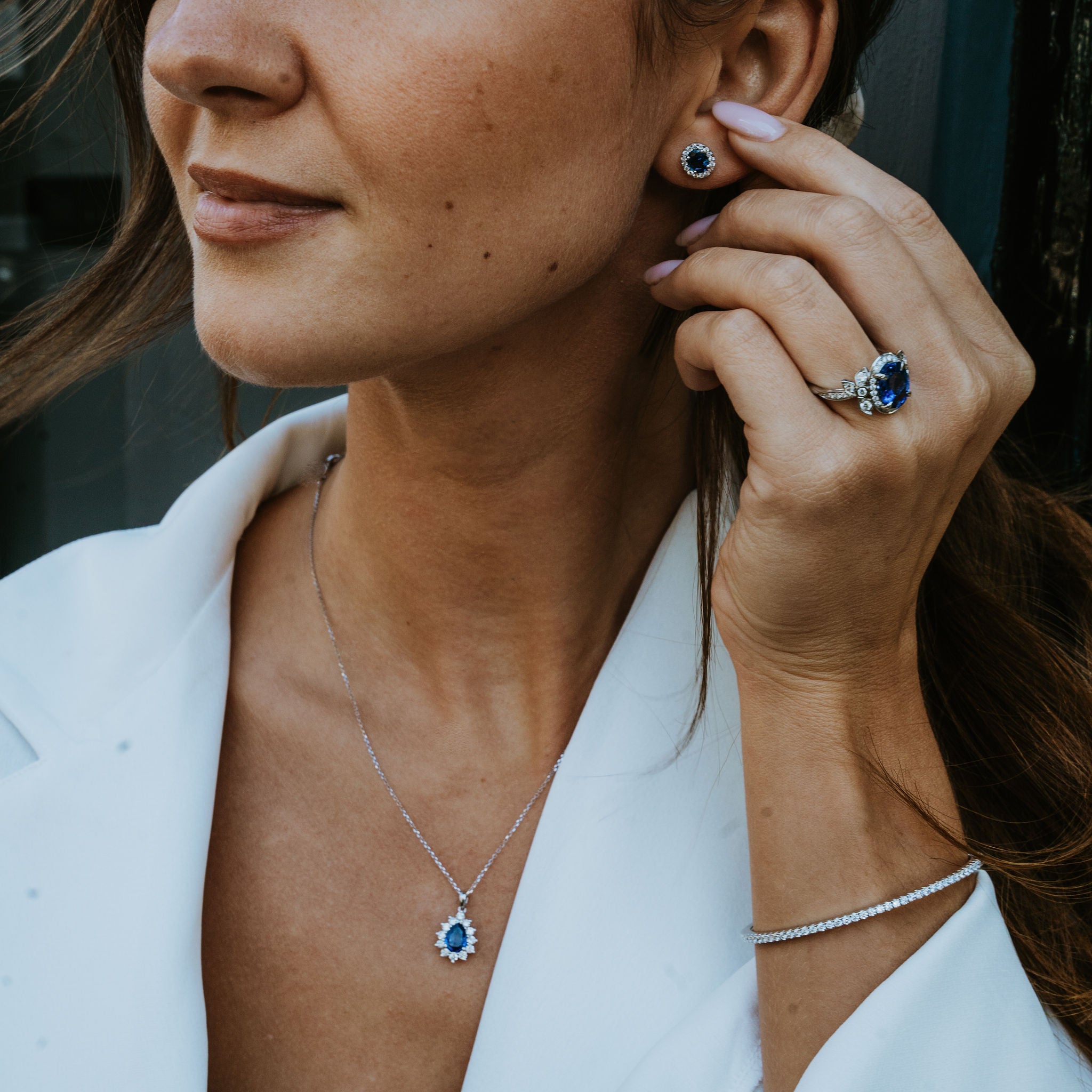
A primary characteristic of such rings is that they use large precious stones. To make them bright and beautiful, the most common approach is to have a coloured gem in the middle, with a ring of smaller diamonds in the surround.
What Do Our Cocktail Rings Look Like?
As leading gemstone jewellery makers, it may come as no surprise that this is exactly what we do with our range of cocktail rings, as can be seen here:
From this video, you may notice a few details about the gems we use:
- Four types of gemstones are classed as ‘precious’: diamonds, sapphires, rubies and emeralds
- Diamonds are used as the surrounding cluster for all these rings
- The sapphires we use are larger than the emerald and rubies
- The emerald and ruby are held in place by protective prongs
Although primarily decorative in the case of the ruby, the use of protective prongs has an extra purpose for the emerald. This is to help ensure that this cocktail ring has as long a life as the others.
While diamonds are the hardest substance on earth, measuring a maximum 10 on the Mohs scale, corundum (sapphires and rubies) is next, measuring 9. Emeralds, at 7.5-8, are comparably soft and can be prone to being chipped.
For this reason, an emerald should always have extra protection to ensure it will last just as long and that you have a choice between red, blue and green gemstones. However, as the ruby shows, it is a style that can work with other gems as well.
In other respects, emeralds are great for cocktail rings, precisely because they are not for everyday use but for special occasions, meaning they are not at risk of wear and tear from being worn all the time.
Quite simply, this is a ring that stays in the jewellery box just as your fanciest dress remains in the wardrobe, until the next grand occasion comes along.
What Is The History Of Cocktail Rings?
Not everyone has always used precious gemstones in cocktail rings. At first, they did, for the practice of wearing cocktail rings began in the 1920s, the time of the roaring twenties and flappers with their feather boas and pearl necklaces.
This was also the Prohibition era, when wearing a ring with a diamond on the right hand was a secret signal that the lady was there to drink alcohol at an illegal speakeasy. These drinks were usually cocktails, hence the ring’s name.
This was also a time of ostentatious wealth and success, a giddy time when it seemed like the economic boom years would never stop. It may be no surprise that other gems soon appeared and became the dominant characteristic of these rings.
However, times changed dramatically, firstly as the economy nosedived following the stock market crash of 1929, while the end of prohibition killed off the speakeasies.
Stripped of wealth, ladies would still wear bright and loud cocktail rings when going out for a (now legal) drink, but now, many of these featured coloured glass instead of gemstones.
Cocktail rings continued to be popular, peaking just after the Second World War when living standards were higher again, but suffered a dip in popularity in the 1960s.
Come the 1980s, they recovered; a decade of big hair clearly needed big rings to go with it and they have remained popular ever since. After all, one thing that will not go out of fashion is a big party.
Even so, there are some common misconceptions about cocktail rings, so it is not surprising that we encounter a lot of frequently asked questions.
Frequently Asked Questions About Cocktail Rings
Q) Are cocktail rings still in style?
This is the easiest question to answer, with an emphatic yes! Just remember, the fact that they are rings for a special occasion should not mislead you into thinking they aren’t fashionable just because you won’t see them in everyday situations.
Q) Can you wear a cocktail ring every day?
Technically, the answer is yes, but unless you are very popular and go to an awful lot of parties, that really isn’t the idea. They are large and thus not all that practical.
This is not a wear and tear issue, of course, at least when diamonds, rubies and sapphires are involved. However, because of their comparative weakness, emeralds should not be worn every day.
Q) Which finger do you wear a cocktail ring on?
Traditionally, these rings are worn on the right hand. As mentioned above, this was used as a secret signal for illicit drinkers in the American Prohibition era.
On a practical note, this also distinguishes them from a wedding or engagement ring. If you are single, you might not want to confuse anyone about your status, especially if you have any hopes of meeting someone at the party.
Moreover, by wearing it on your right hand, you can still happily sport one if you are engaged or married, with the ring or rings to demonstrate it.
Q) What's the difference between a cocktail ring and a dinner ring?
As mentioned above, there is a misconception that a ‘dinner ring’ is just a different name for a cocktail ring.
In fact, dinner rings predate cocktail rings, emerging among the wealthy in the late 19th century. They tended to be bought by women themselves rather than as gifts from boyfriends or husbands, unlike cocktail rings.
Furthermore, dinner rings tend to be dominated by diamonds rather than coloured gems and are seen as generally more refined and elegant than cocktail rings.
They enjoyed a late flourish in popularity in the 1960s and 70s after cocktail rings briefly fell out of fashion. They remain an alternative form of dress ring, but are stylistically distinct.