
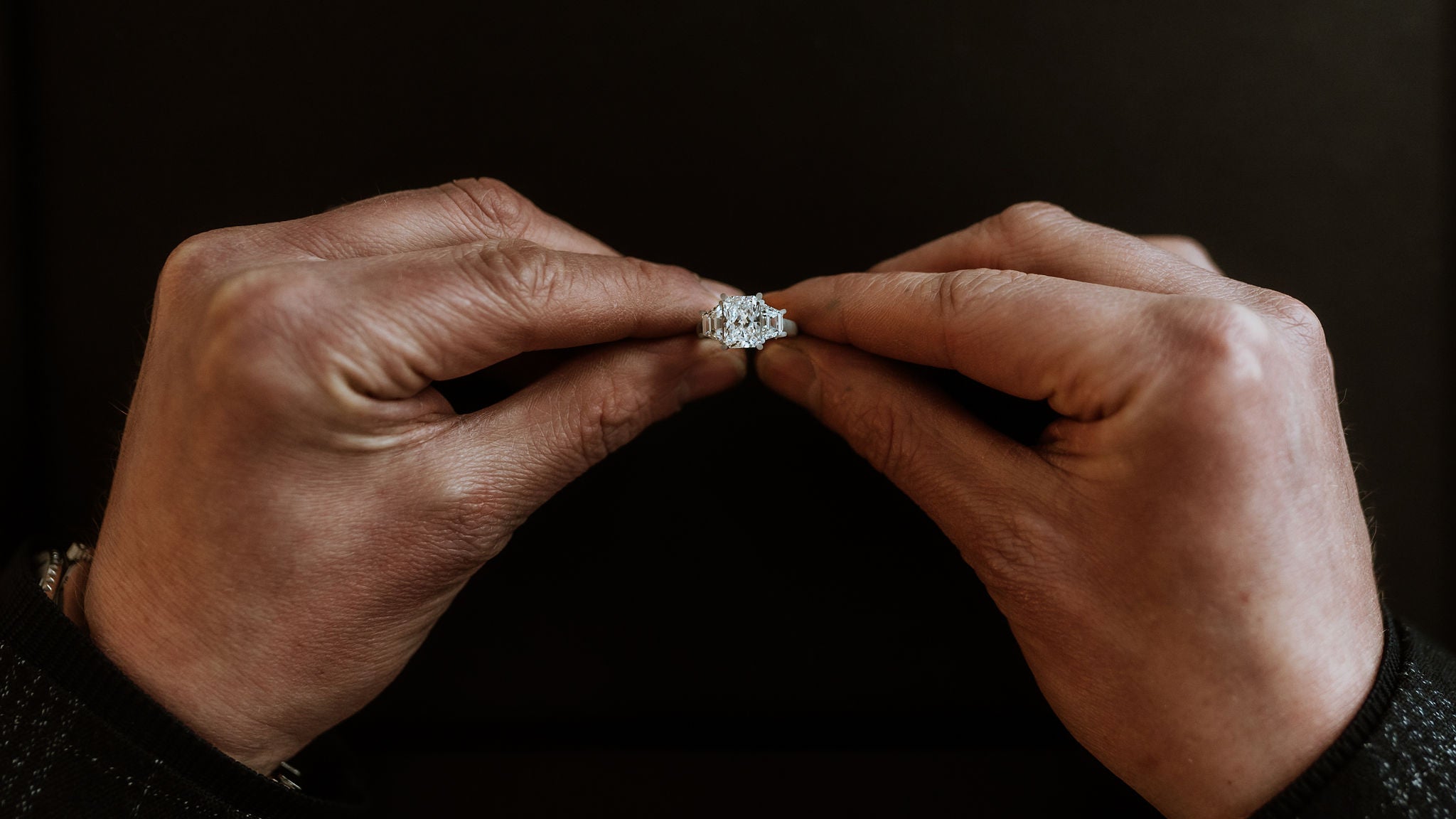



When choosing or commissioning a piece of jewellery, there are many factors to consider. Usually, these are design-based, such as the type of precious metal, the shaping of the stone, and the settings. After all, you want a piece that is beautiful and eye-catching to wear.
However, another consideration is how sustainable and ethical your jewellery is. Knowing that the making of your statement necklace or ring is as
Much of the debate over ethics and sustainability surrounds diamonds, in particular mined conflict diamonds. Knowing a diamond's origins can make that ring, necklace or earring feel beautiful as well as look stunning when you wear it.
A good jeweller will be able to provide a certificate of origin under the Kimberley Process for mined diamonds or give a traceable identifier for lab-grown rocks. That way you can be sure that the gem is conflict-free and ethically mined.
But diamonds are not the only precious stone in the jeweller's workshop; coloured gemstones can be used to elevate pieces and create unique, bold jewellery.
What coloured gemstones are used in jewellery?
Gemstones come in a rainbow of sparkling colours, each with their own particular allure and characterisation. Among the most popular are:
- Ruby – a famously bold red
- Garnet – the ruby’s darker red, almost brown cousin
- Sapphire – usually a bright blue but can also be pink, yellow or green
- Emerald – a vibrant green
- Opal – a chameleon that changes with the light
These are the most famous and sought-after coloured stones; of course, there are many other, more rarely used stones such as citrine, peridot and tanzanite.
Where do gemstones come from?
Coloured gemstones, like diamonds, are mined from the earth. They are made over millions of years, subjected to immense pressure and heat, then brought nearer the surface in a combination of tectonic events and erosion.
Geographically, Africa is the biggest resource for gems, in particular Mozambique, Tanzania, Zambia and Madagascar. Myanmar, Sri Lanka and Brazil are also known for supplies of precious coloured gemstones.
Diamond mining is a big industry undertaken on a massive scale, and although mining has a major environmental impact, much of the industry is better regulated than it has been.
In contrast, much of the coloured gem mining is artisanal or small in scale, and sometimes they are even mined by hand, rather than by machines.
Unfortunately, this is where ethical issues can occur, particularly in poverty-stricken parts of the world where children are in the workforce, and a lack of regulation means the work is high risk.
Like diamonds, sales of gemstones such as rubies and sapphires have a brutal history of funding violent conflicts, extremist groups and human rights violations around the world.
What is also concerning is that there is no Kimberley Process in place for coloured gemstones, so there is no official way to regulate sales and certify the origins of some stones.
Trusted supply chains and ethical gem dealers, such as those used by Liam Ross, are one way to ensure that the gemstones in your jewellery are guilt-free. Another is to purchase lab-grown crystals.
Can coloured gemstones be lab-grown?
Like diamonds can be grown in laboratories, many coloured gemstones can be artificially created. The synthetic crystals are identical to naturally mined versions in their physical and chemical make-up.
The first artificially made gemstone was a ruby, not a diamond. It was grown by a chemist in the early 1800s, and then the process was improved by Auguste Verneuil in 1902. But it has taken until the 21st century to make the process of growing gems efficient and cost-effective.
There are various methods of replicating the results of applied heat and pressure that the atoms would undergo if it were created naturally. The difference is that there is no mining, and you do not have to wait hundreds of thousands of years for the resulting gem.
There are a few precious gemstones that cannot be replicated in a laboratory environment.
Gems made from biological matter include:
- Pearls, which are made in oyster shells
- Amber, which is tree resin that has been fossilised
- Jet, which is fossilised trees
There are other precious gemstones whose crystalline structure is not as pure, meaning they cannot be recreated in a lab. Much of the reason is that technology is not advanced enough to make stones like opal, moonstone or lapis lazuli in the laboratory.
Instead, we must make do with stunning lab-grown corundum such as rubies or sapphires, and beryls such as emeralds, and many rarer options too. In the same way that lab diamonds have to be identified, the sale of artificial gemstones is regulated by industry organisations.
Does shape and clarity matter for coloured gemstones?
The shape and the clarity of a coloured gemstone are both factors in how it is valued. However, they do not have the same impact as they would on the value of a diamond. The boldness of the colour is actually the biggest value factor for a gemstone.
Saturation or depth of colour, tone, and hue are all elements that need to be considered, and the optimum will vary between types of gems. Uniformity is also important, so that one side or portion is not darker or blemished.
There should be no visible inclusions or flaws, but a loupe is not usually needed for extra magnification. The amount of permissible inclusions will vary with gem type, depending on the depth of colour; for example, lighter coloured stones should be clearer.
The shape also comes into play, although it is less important in coloured stones. The most vital is that the cutter does not muddy the colour with a poorly chosen shape.
How can you incorporate coloured gemstones into jewellery?
Given that the difference between lab-grown and mined coloured gemstones lies almost entirely in the ethics, synthetic gemstones might be the perfect choice for your next piece.
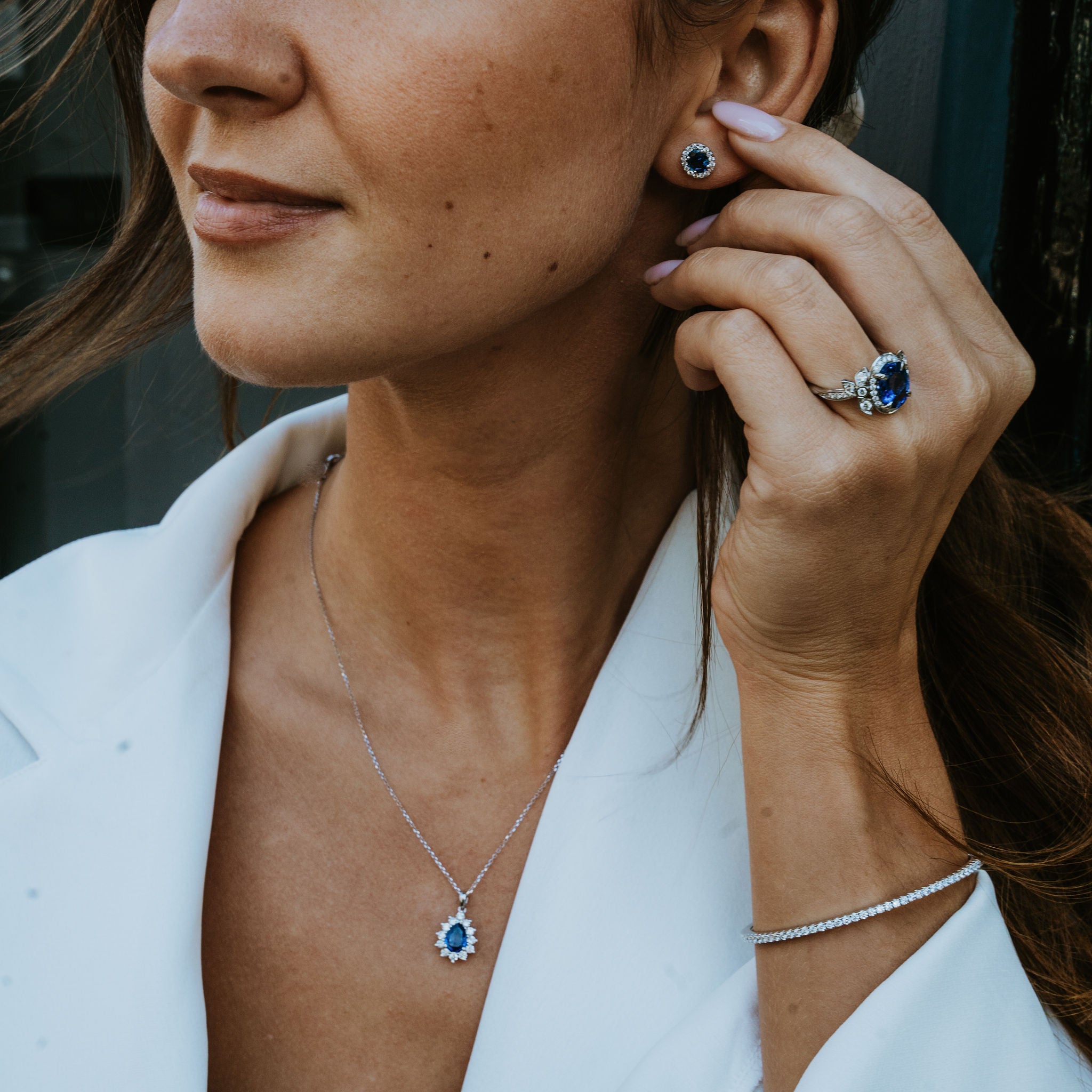
Coloured stones can be used in almost any type of jewellery that would usually feature a diamond. For example, diamond engagement rings can feature an emerald or sapphire instead. Other examples include:
- Toi et moi rings
- Eternity rings as an alternative or highlight colour
- A pendant necklace
- Earrings encrusted with gemstones
- Bangles and bracelets with stones embedded
There are so many ways to play with colour in gemstone jewellery design, and to create a bespoke statement with a bright gemstone.