
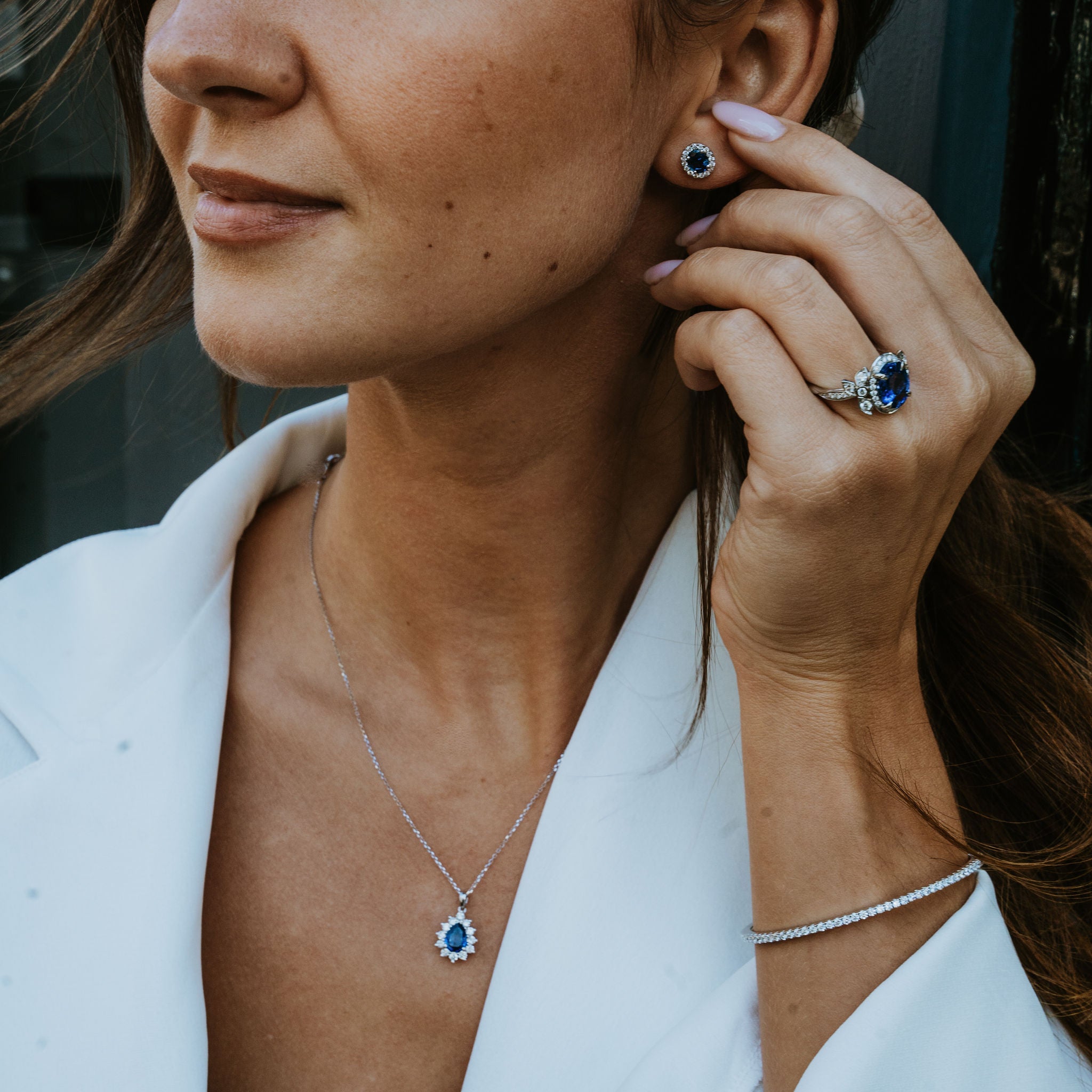


The Diana Ring is one of the most iconic styles of engagement rings around, with many buyers looking to copy the style. However, as an alternative, you can always have your own bespoke variation on the theme.
Some styles of ring may be named after the number of gems, such as a solitaire or trilogy ring, but the combination of a large blue sapphire ringed by diamonds is an iconic style connected with one of the most famous women of the late 20th century.
When the then Prince Charles announced his engagement to Lady Diana Spencer in early 1981, the event itself naturally gained huge global media attention. It was, therefore, inevitable that the ring would get some attention too.
What Was Unusual About The Diana Ring?
What was noticeable was how unusual the design was. It was not the customary diamond, but a sapphire, taking centre stage. Curiously for such an unusual ring, it was actually chosen from a catalogue rather than being a bespoke product from a royal jeweller.
Officially known as a sapphire halo engagement ring, this was a clear departure from the norm precisely because any member of the public could, in theory, have gone and bought it. This meant it became simultaneously iconic and accessible.
Of course, the legend of the ring did not stop there. The marriage was anything but a fairytale and, in 1997, the princess’s life ended in tragedy at the age of 36 after a car crash in Paris.
However, the story of the ring was to have a second chapter, as her son Prince William was to place it on Kate Middleton’s finger when they got engaged. The ring that made so many headlines in 1981 is still centre stage today.
Naturally, the iconic nature of the Diana story and its new expression through its role in a present-day royal marriage has made it a highly popular style of ring. But should fans want an exact copy of it, or a slight variation?
What Were The Details Of Diana’s Ring?
The specifications of Diana’s ring were as follows:
- The central stone was a 12-carat Ceylon sapphire
- It came in an oval cut
- The halo has 14 round-cut diamonds
- It was made with 18-carat white gold
- According to Vogue, the cost was £28,000, which is £123,000 in today’s money
Such features provide a lot of fascination, but also provide a reality check. Yes, another member of the public could have bought the same ring, but they would have needed very deep pockets to do so.
Of course, if you really do have so much to spend, we can produce a ring to the same (or very similar) specifications. However, there are many other ways to approach the design, with a few bespoke modifications that can retain the style while remaining affordable.
An obvious place to start is the sapphire. While the carat system is a mark of purity in gold, it is a measure of size in gemstones. Just as a solitaire diamond need not be as big as those sported by wealthy celebrities, so your sapphire need not be as large as Diana’s.
In turn, this also means the size of the halo can be smaller. That means either the diamonds can be of a smaller size, or there can be fewer of them, so this will also lower the cost while retaining the design.
You may also have an alternative approach with the metal. It does not need to be white gold, of course, as you could choose yellow or rose gold, while the 18-carat measurement is at the higher end of the purity commonly used in jewellery.
Indeed, the use of 14-carat gold will make the metal a little more resilient and scratch-resistant than 18 carat. This might be appropriate for ladies who might be more likely to get their hands dirty undertaking menial tasks than a princess would.
What Are The Alternatives To A Blue Sapphire?
Another approach might be to vary the central gem itself. Those who love diamonds could go for the diamond as the central stone with a halo of them, although this would certainly not lower the cost and it would not have the same iconic look or colour contrast.
Alternatively, you could use a different gemstone, particularly another type of corundum (the class of stones that sapphires and rubies belong to).
Of all corundums, most are classed as sapphires, which consist of the traditional blue and other gems that are known as ‘fancy sapphires’ of varying colours. The exception is rubies, which are corundums with sufficient chromium to give them their familiar red colour.
This would mean simply substituting a sapphire for a ruby, with the same style but a different colour, which may be preferable if you like red as an alternative to blue.
In the same way, you can use a fancy sapphire to produce the same style but with a different central gem colour.
Are There Any Other Royal Variations On The Diana Ring?
There have been royal instances of exactly this. When Andrew Mountbatten-Windsor (formerly Prince Andrew) proposed to Sarah Ferguson, the ring was a ruby with a halo, literally a red version of the Diana ring, perhaps reflecting ‘Fergie’s’ hair.
Subsequently, their daughter Princess Eugenie received an extraordinary version from Jack Brooksbank when he proposed to her, a Padparadscha sapphire. This is a very rare form of fancy sapphire with an orange-pink colour.
Needless to say, Mr Brooksbank, a senior marketing executive, had plenty in the bank before he shelled out for this ring, but this was an example of how a fancy sapphire can produce a variant on the Diana Ring effect.
We have previously written about how we have used pink sapphires in rings and this is indeed an option. So, too, are other fancy sapphire colours, including bright orange, yellow, green or purple.
These sapphires are not as rare, nor as treasured, as a Padparadscha sapphire, so you can copy a Brooksbank without breaking the bank.
With several options available that will be well within the budgets of most people, you can seek out your own version of the Diana ring, adding in some personal design elements that mean, for all its iconic style, it remains something with a unique element, just for you.